

We are launching a series of articles dedicated to optimizing laboratory processes, covering the entire value chain: from receiving a quote request to issuing the invoice and collecting payment.
In this first article, we present the case of Orion Laboratory (a fictitious name to preserve anonymity). Orion is a laboratory with a turnover of 2 million euros, accredited under ISO/IEC 17025, which analyzes samples from various sectors, including environmental (water and soil).
What is the situation at Orion Laboratory?
The laboratory has a 30% delay in delivering results, a very low gross margin (10%), and a deviation rate (Z score ≥ 2) above 5% in proficiency testing results.
As a result, Orion is in a critical situation: loss of clients, deteriorating credibility, and rising direct costs due to extensive overtime worked by the team in an attempt to reduce delays.
In addition, the staff is demotivated due to excessive workload and the lack of visible improvements in turnaround times.
The challenge is clear: improve laboratory operations without compromising quality, implementing quick, low-cost, high-impact changes to reverse the situation.
It is important to note that Orion Laboratory has a limited budget for implementing improvements, so every change must be low-cost.
Given this situation, the laboratory’s overall situation must be evaluated in detail, including sample workflows, workload per area, workspace organization, and all the stages involved in the analysis process.
Initial Evaluation
To address the problem, the laboratory’s operation is analyzed in detail:
-
Sample workflows
-
Workload by area
-
Workspace layout
-
Processes involved in the analysis cycle
Key Issues Identified
- Lack of sample prioritization.
- Non-optimized layout, with overcrowded and underutilized areas.
- Unnecessary technician movement between areas and equipment.
Once the improvement opportunities are identified, how can they be addressed with small changes that each have a positive impact?
1. Sample Prioritization
Sample prioritization is essential for proper laboratory operation. That’s why, after sample registration, it’s vital to ensure samples are identified in a way that allows quick visual recognition of urgent cases or those with a shorter “turnaround time” (TAT). Orion Laboratory prepares aliquots of each sample to be sent to the respective areas for analysis.
For improved prioritization, a color-coding system was designed, identifying 5 urgency levels:
- Immediate analysis
- Results within 24h
- Results within 2 days
- Results within 3 days
- Results in over 3 days
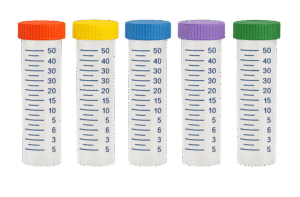
A specific color was assigned to each category, and Falcon tubes and racks in matching colors were purchased to quickly identify urgency and workload..
3. Reorganization of Samples and Workflow
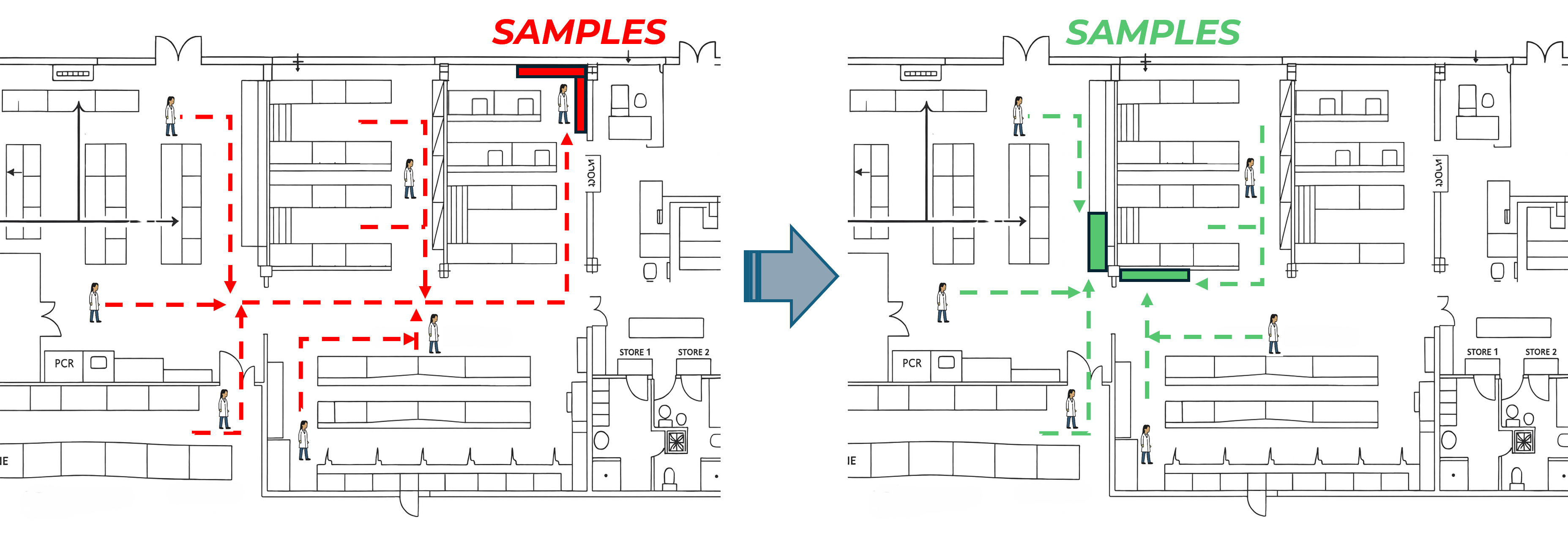
Although the lab already prepares aliquots, samples are stored in a common area, which requires analysts to make multiple daily trips and makes it difficult to see the overall workload.
Sample locations were redesigned, improving visibility across areas and significantly reducing staff movement, especially in the areas where 70% of analyses are carried out.
Equipment Layout Optimization and 5S Housekeeping
Regarding equipment layout:
-
The number of analyses per instrument, types of analyses by sample type, samples with the highest analysis volume, and busiest areas were evaluated.
-
Based on this, equipment was reorganized to:
-
Free up space in high-traffic zones
-
Workflow improvement
-
Group equipment by sample type, increasing operational efficiency
-
In addition, benches, cabinets, and shelves were reorganized using the 5S methodology to make the analysis process more efficient for technicians, keeping materials accessible and locatable within just 30 seconds.
Results Achieved
Thanks to these improvements and at very low implementation cost, significant results were achieved:
-
-
Reduction in delayed samples: from 30% to 13%
-
Increase in gross margin: +4%
-
Enhanced analytical quality: achieved the target of 5% deviation n proficiency tests
- Improved employee satisfaction
-
Orion Laboratory’s case demonstrates that process optimization doesn’t always require large investments but rather strategic vision and data-based decisions.
Small, well-designed improvements can have a huge impact on efficiency, profitability, and perceived quality in the laboratory.
In upcoming articles of this series, we will address other key areas such as sample registration, results validation, billing and payment collection, laboratory digitalization, and technical staff management.
Ready to optimize your laboratory processes?
Discover how to improve efficiency without major investments: